Welcome to Sensory Spark
Free sensory games, personalised activity plans, curriculums, communication tools and guides — built for SEND teachers, TAs and families. Pick a card to get started.
This homepage links to everything on Sensory Spark: free games and printables, premium tools like Speak Spark, curriculum documents, and staff training. Scroll down or use the menu at the top to explore each area.
Tools
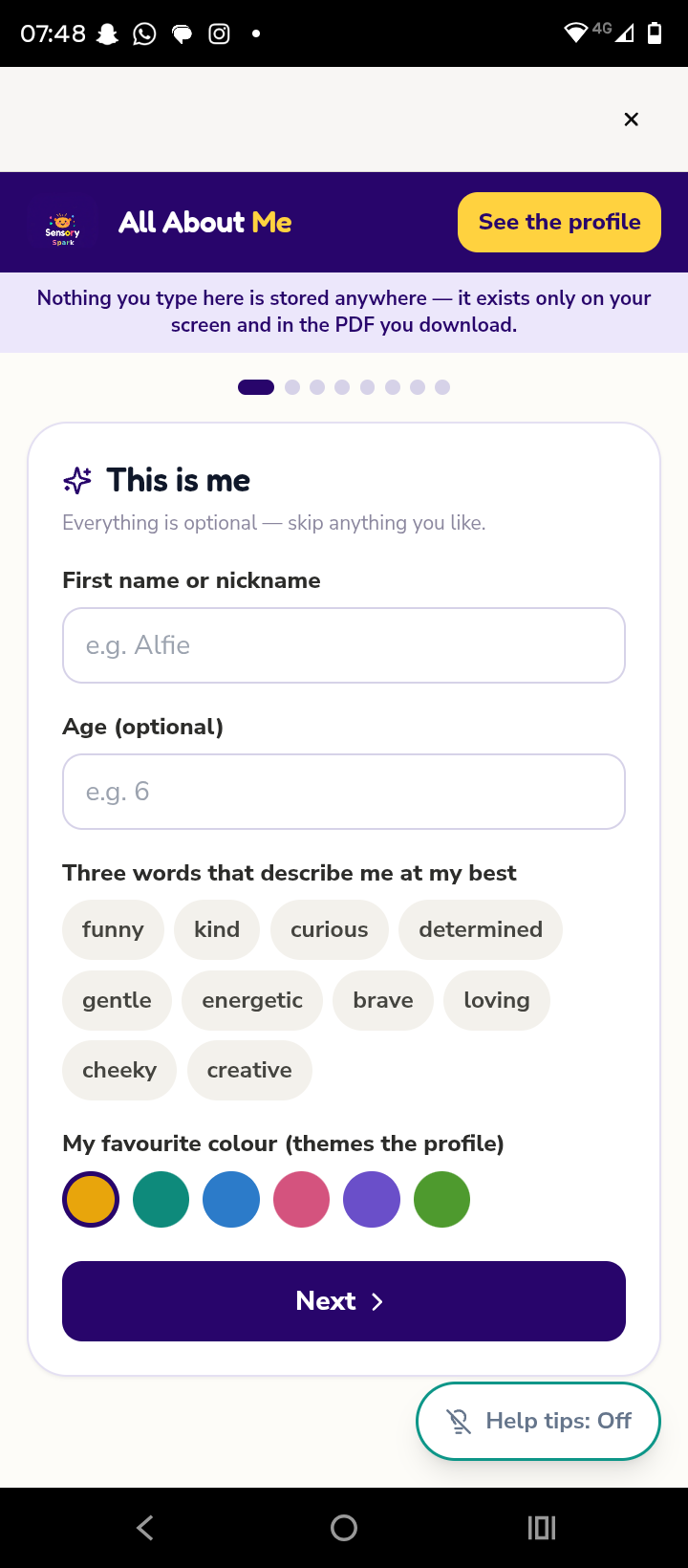
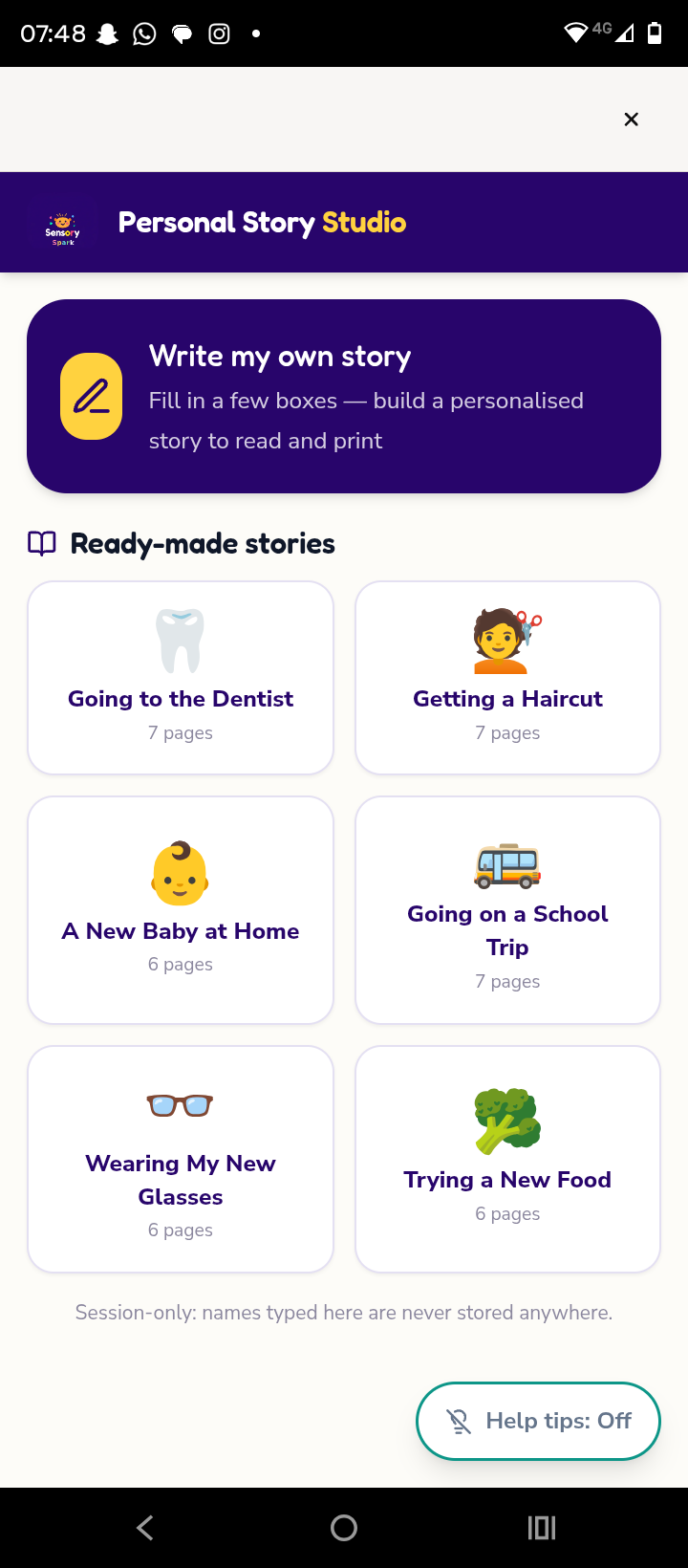
Pupil profiles and social stories
Two specialist tools at £9.99 a year each. Have a free look at each one first.
Start free — most of Sensory Spark costs nothing
Everything below is free to use today, on a tablet, laptop or whiteboard. No account, no card, no trial clock.
- 32 sensory, SLD, SALT and neurodiverse games
- Printable boards, visuals and recording forms
- The complete EYFS curriculum + teaching guides

"But it's AI-generated…"Here's how Sensory Spark actually works
We know what you're thinking. AI-generated content has a reputation: generic, sometimes wrong, and written by something that has never stood in front of a class. If you're cautious about using AI-generated anything with children who have complex needs, good — you should be. Here's why Sensory Spark is different.
The curriculum came first, not the AI
Sensory Spark didn't start with an AI. It started with a curriculum — three of them, in fact: Early Years, KS1 and KS2, each written specifically for children with SEND, including those with PMLD and SLD working well below age-related expectations.
Those curricula weren't generated by a machine. They were built by hand, alongside practising SEN educators, and aligned to the frameworks you already work to:
- The EYFS Statutory Framework — all seven areas of learning, mapped to the Early Learning Goals
- The National Curriculum for KS1 and KS2
- The DfE Engagement Model (2020) — the statutory assessment framework for pupils not engaged in subject-specific study
- The Pre-Key Stage Standards
- Occupational therapy sensory integration principles — covering all eight sensory systems
- Benchmarked against established SEN curriculum standards, and reviewed against the current Ofsted inspection framework
That's the foundation. Every single activity in Sensory Spark is built from it.
The AI doesn't invent — it applies
This is the crucial part. The AI in Sensory Spark is not asked to "come up with some activities for SEN kids." It is required to read and work within the full curriculum document for the relevant key stage, and every activity it produces must map back to a specific curriculum objective — a named Early Learning Goal, a National Curriculum link, an Engagement Model area.
Think of it less like asking a chatbot for ideas, and more like giving a highly capable teaching assistant your school's curriculum and planning format and saying: "differentiate this objective for my class, in this structure, following these rules." The pedagogy is ours. The AI does the legwork.
It is not a search engine scouring the internet
Sensory Spark doesn't go looking for activities online, and it doesn't copy anything from a blog, a Pinterest board or a resource site. There is no web search involved at any point.
When you press generate, the only material in front of the model is our own curriculum documents, the statutory frameworks they're built on, and the choices you made on the form — key stage, subject, duration, setting, budget and the learner's sensory profile. The activity is written fresh from that, for those specific inputs.
- No internet search, no scraped content, no lifted worksheets
- The curriculum document for your key stage is the source material — every time
- Your form choices shape the plan, so two different learners get two different activities
- Activities are checked against the named subject and strand before you ever see them
It can only make what it's allowed to make
The generator is deliberately fenced in. It can only produce activities for subjects that exist in our curriculum and frameworks for the key stage you chose — ask it for anything outside that and it simply won't run.
There are hard content rules on top of that, applied before anything is generated. Nothing rude, offensive, sexual, violent, discriminatory or otherwise inappropriate can be produced, and no wording in the request box can talk it out of those rules. Relationships and personal-care content, where it belongs to a named curriculum strand, is written in factual, safeguarding-led language only.
If a request falls outside the curriculum or the content rules, it's refused — and you aren't charged a credit.
Every activity follows the same professional structure
Nothing comes out as a vague paragraph of suggestions. Every activity is generated in a fixed, practitioner-designed format:
- Clear preparation, introduction, main activity and wrap-up
- Sensory differentiation — separate guidance for hyper- and hypo-responsive children across the sensory systems
- Engagement Model links for pupils working below subject-specific study
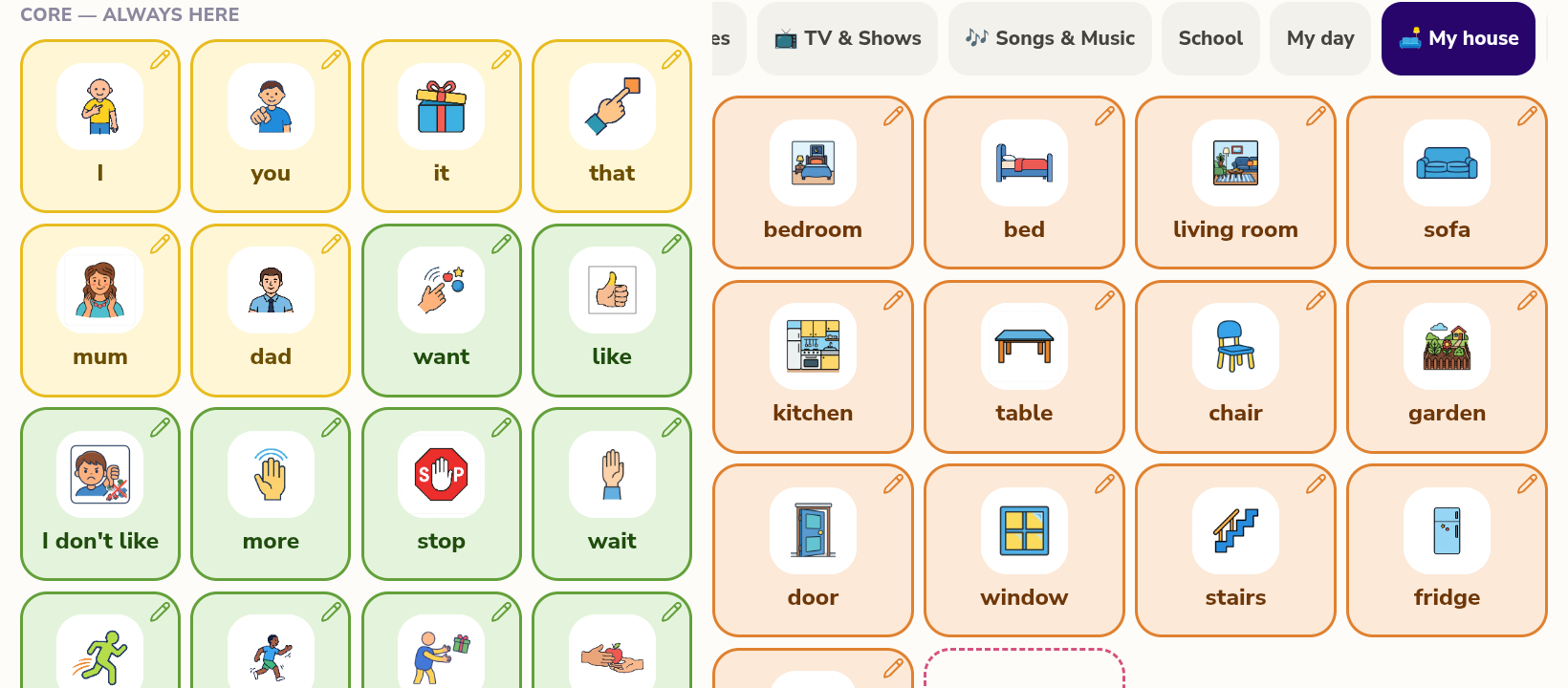
- Core vocabulary and AAC support, including core board prompts for non-verbal learners
- A progression framework so small-step, lateral progress can be evidenced
- Curriculum references, so you can show exactly where it sits in your coverage
If the AI can't tie an activity back to the curriculum, it doesn't belong in the app.
You stay in charge
Sensory Spark generates plans; it doesn't teach children. You are the professional. Every activity is there to be reviewed, adapted and approved by you — swapped, tweaked, or regenerated for an individual child who needs something different. Nothing bypasses your judgement, and nothing is put in front of a child without a teacher deciding it should be.
Why use AI at all, then?
Because the maths of SEN teaching is brutal. Differentiating one mainstream objective properly — sensory profiles, communication needs, engagement levels, individual targets — can take longer than teaching it. Multiply that across a class and a week, and it's hours of planning time that could be spent with children.
Sensory Spark uses AI for exactly one job: doing that differentiation legwork instantly, inside a curriculum that humans built and educators trust. The expertise is human. The frameworks are statutory. The speed is the only part that's artificial.
For schools & settings
Curriculum and staff training
Start with the free EYFS curriculum, and give your whole team CPD training they can work through.
Early Years Sensory Curriculum — August 2026 edition
The full 12-page PDF, aligned to the EYFS statutory framework 2026 edition: all 7 areas of learning and all 17 Early Learning Goals, 70+ sensory activities scaffolded across 5 support levels with Encountering → Emerging → Developing → Secure descriptors, the Characteristics of Effective Learning, a statutory compliance summary and full safety and supervision guidance. Free to download once you've created your free account.
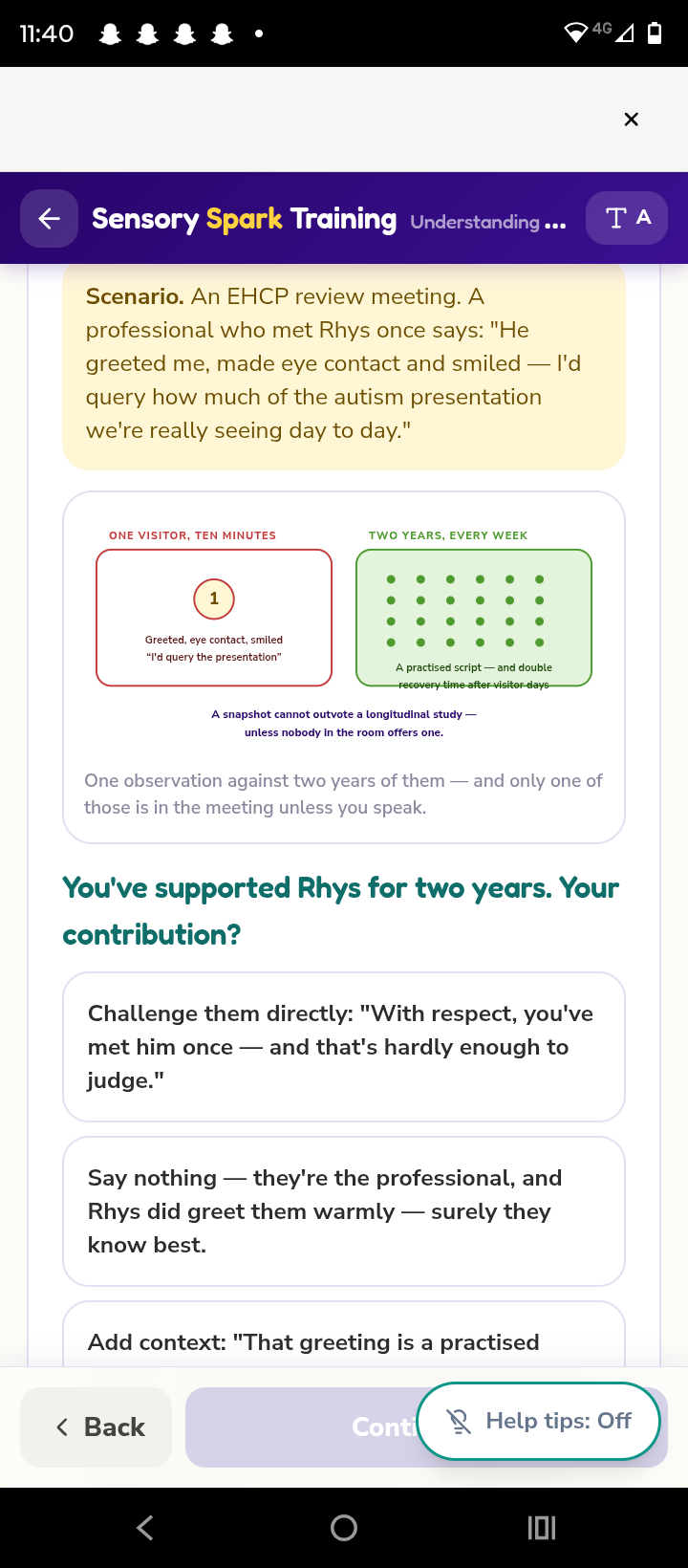
When a pupil is overwhelmed, theory isn't enough. What happens next?
Branching classroom scenarios let staff practise decisions, and see what follows.
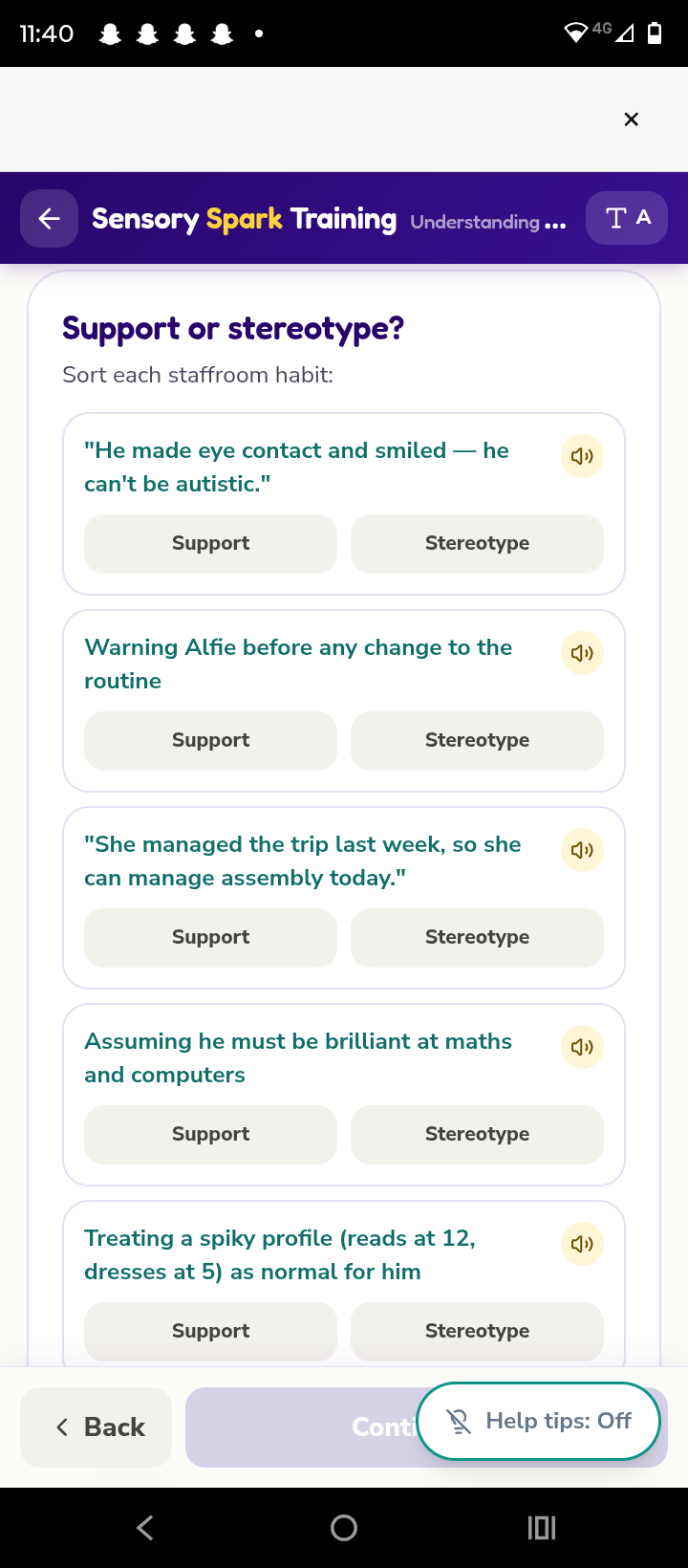 SENSORY SPARK TRAINING
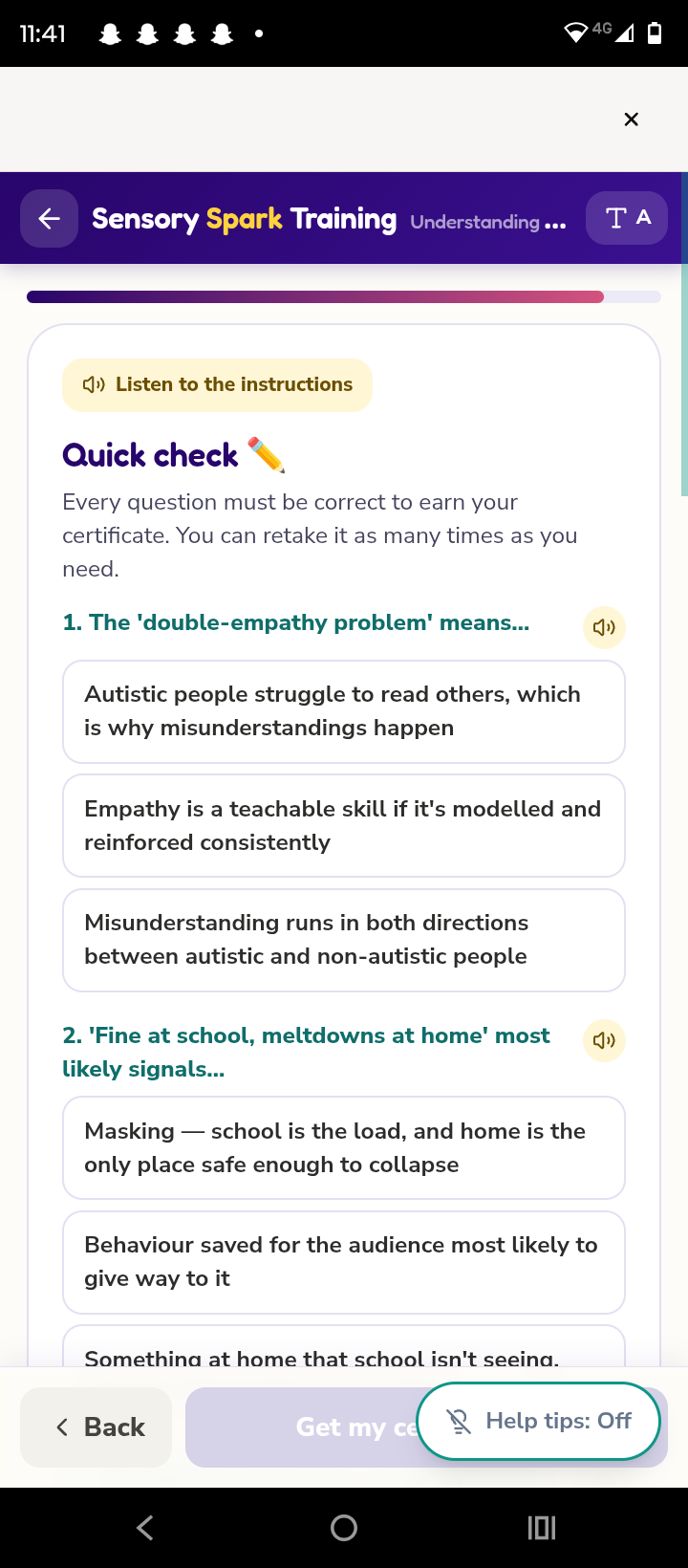
Every module pairs practice tasks with a quiz. Learn by doing.
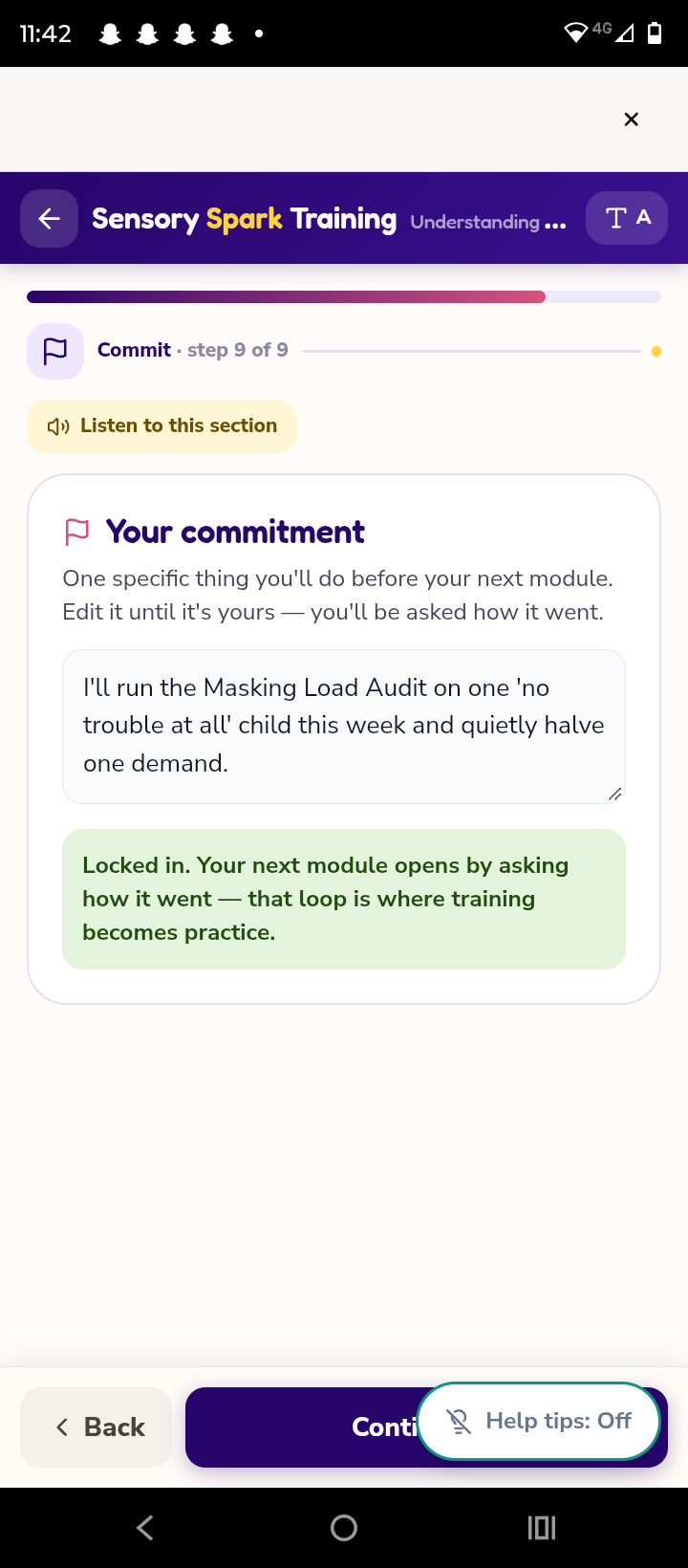 SENSORY SPARK TRAINING
Retrieval questions revisit learning. Set a workplace commitment, then check in next time.
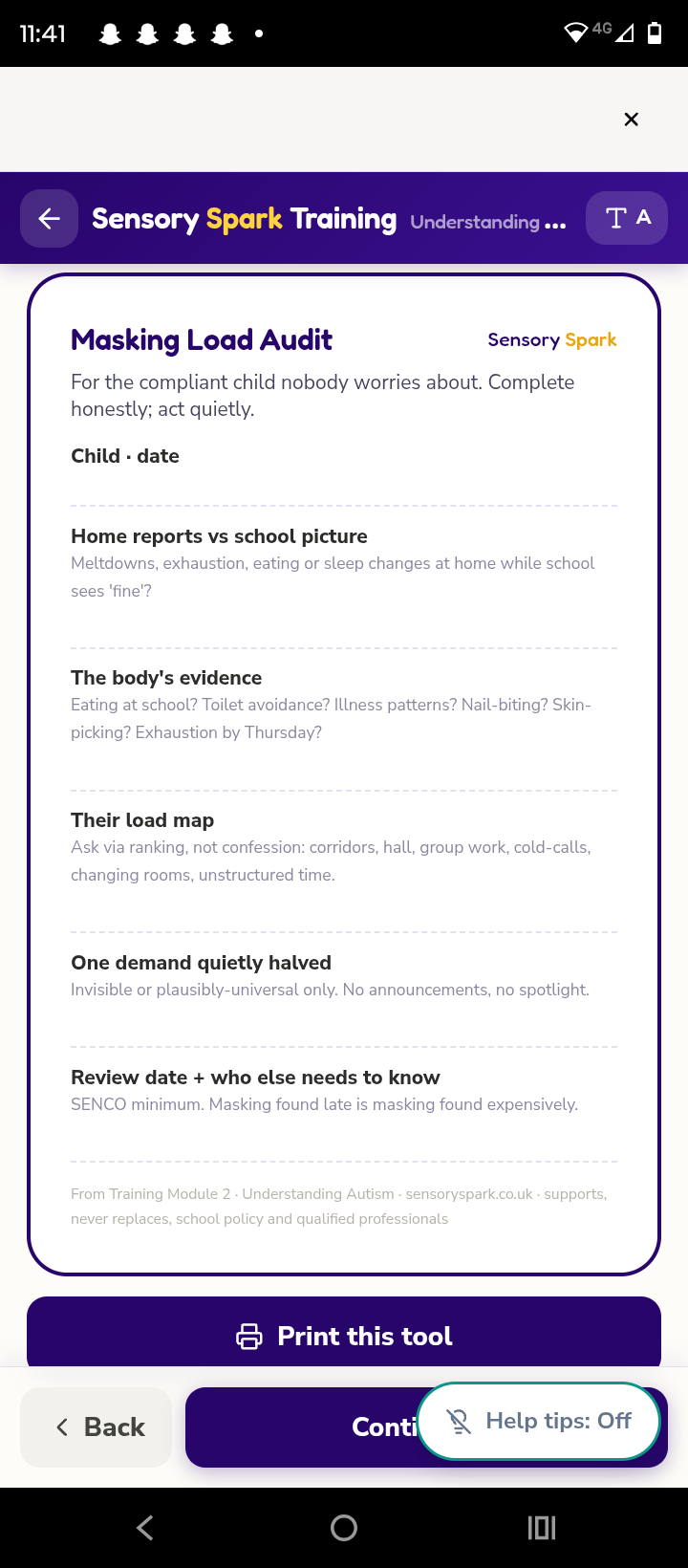
Printable tools go straight into the classroom, ready to use tomorrow.
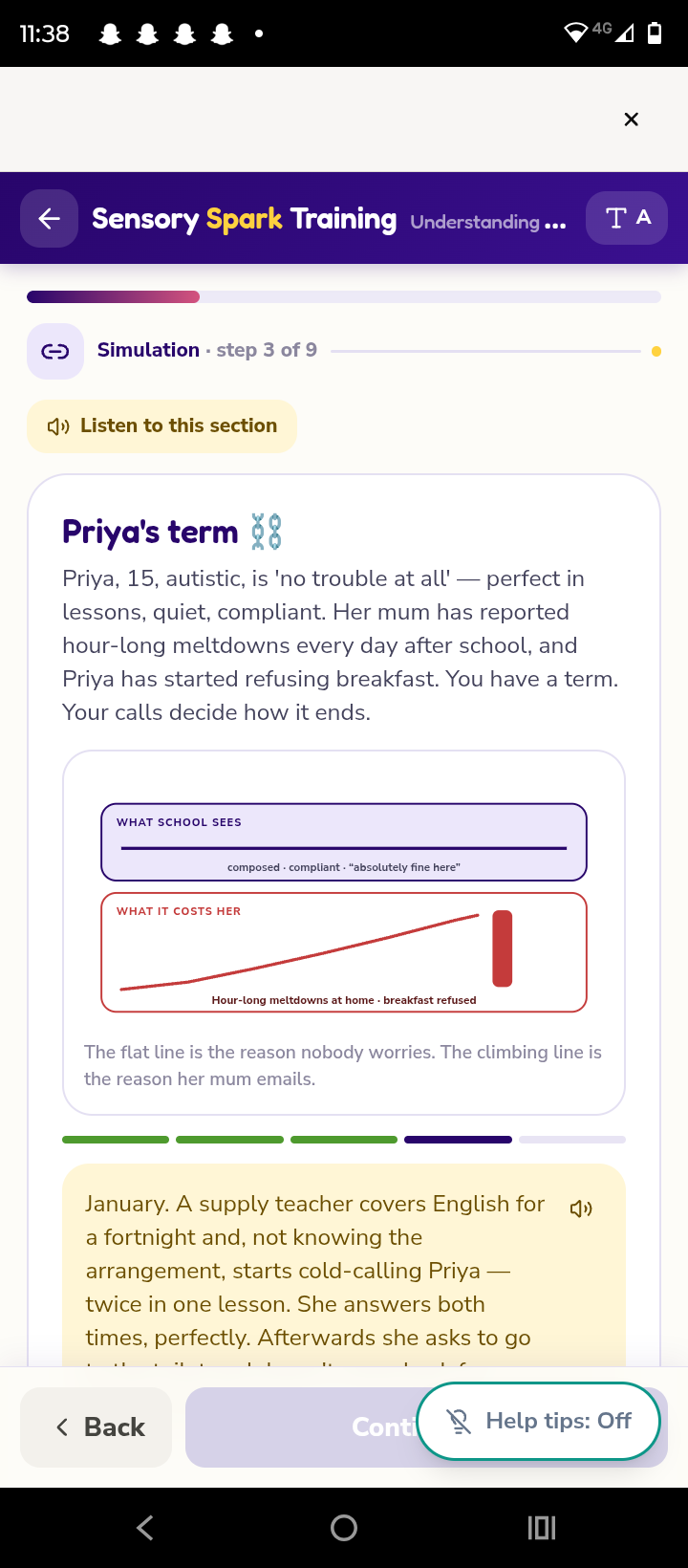 SENSORY SPARK TRAINING
26 modules, six strands, six capstones. Around eight hours of CPD.
 SENSORY SPARK TRAINING
Provider-certified, with referenced certificates for every module and the full pathway.
 SENSORY SPARK TRAINING
Grounded in the SEND Code of Practice. Specialist peer review is underway. We plan to obtain external CPD accreditation.
One annual licence covers unlimited staff for 12 months. Use it for INSET or self-paced learning.
 SENSORY SPARK TRAINING
Try module one free, with no sign-up. Start training your team today.
See Sensory Spark Training in action
Try our first SEND training module free, with no sign-up required. We're seeking external CPD accreditation and it has not yet been awarded. Register your interest below and, once accreditation is achieved, you'll be eligible for the first 12 months of the school licence for £79.99. Registering is free and does not start a subscription; we'll contact you when there's an outcome.
Try the free moduleSpecialist pathways
Support for specific needs and ages
A dedicated Down's syndrome suite, and Spark 11+ for young adults with SEND.
Rated by the people who use it
Explore
More from Sensory Spark
Ready-made packs, the speech and language library and our plain-English guides.
Use it like an app — add it to your home screen
Takes ten seconds, opens full screen, and works from your phone's home screen just like a normal app.
- 1Open this page in Chrome
- 2Tap the ⋮ menu in the top right
- 3Tap “Add to Home screen” (or “Install app”)
- 4Tap “Add” — the Spark icon appears with your apps